

Baby Rose on ‘Yearnalism’, analogue recording and the beauty of real soul
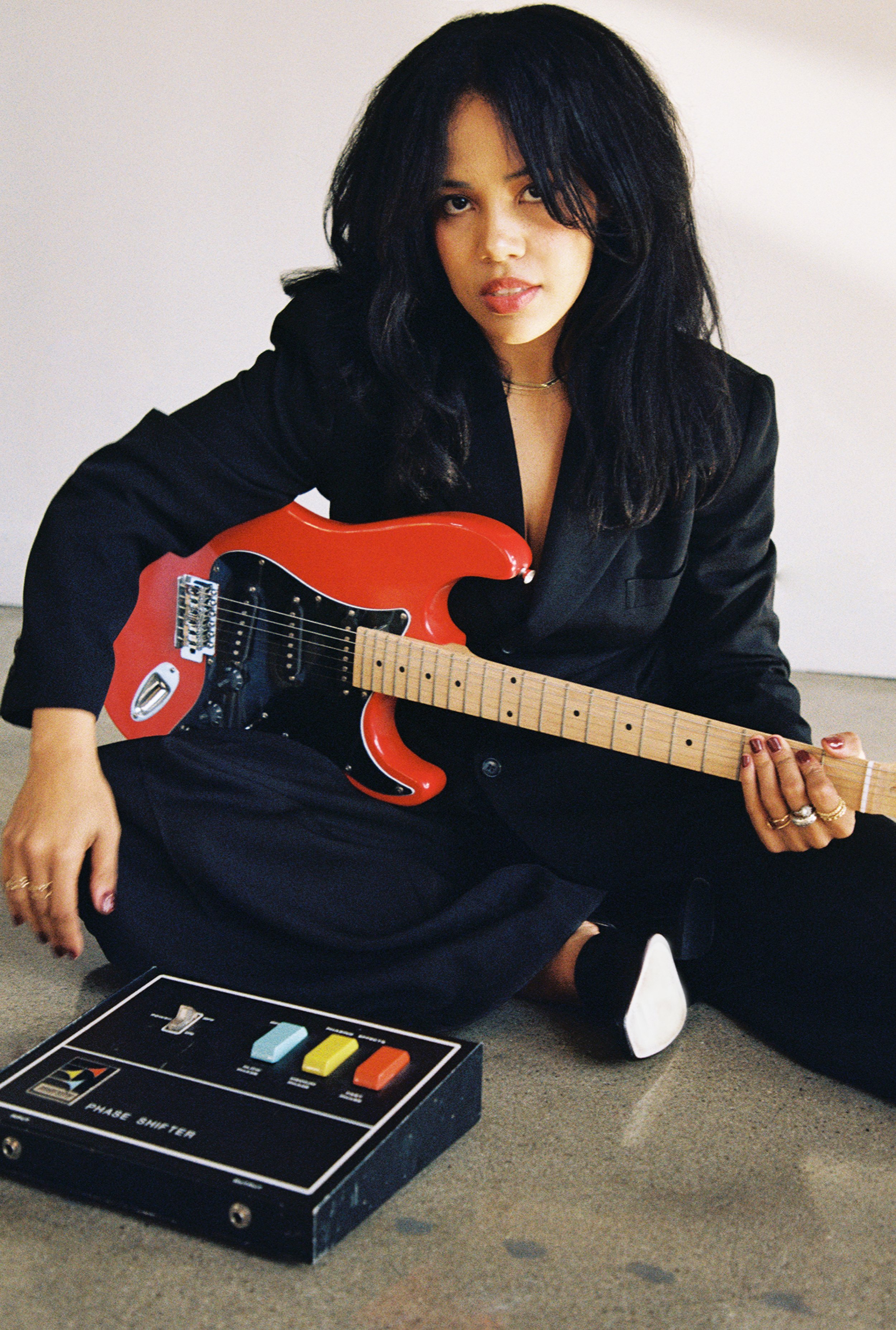
Baby Rose. Photo credit: Louisa Meng
Baby Rose (born Jasmine Rose Wilson) is a Grammy Award-winning singer-songwriter-producer, raised in D.C. and North Carolina. Drawing from soul, jazz, rock and R&B, and working with Leon Thomas, BADBADNOTGOOD, and Vince Staples, Baby Rose has established herself as a truly singular artist with more to give. On the cusp of releasing her third studio album, Yearnalism, coinciding with a supporting bill on Olivia Dean’s USA tour, I find Baby Rose to be in great spirits and in awe of the timing of these landmark career moments. Speaking with Rose, her excitement in sharing new music with the world is infectious. We chat about personal growth through art, the “-maxxing” pandemic, nerding out about analogue gear, and what it means to truly yearn.
★
Guuleed: I've had a chance to listen to the album! It's very confident and really showcases how self-assured you've become as an artist over the years, especially since To Myself. How does it feel talking about a record like Yearnalism?
Rose: It feels really good. I'm always grateful when the art that I share reflects growth. I think this definitely shows a different side of yearning than what I'm used to putting into music, which can sometimes border on self-deprecation. It could be real dark sometimes! So having that yearning for freedom, expansion, and affirmations to encourage myself and others is really beautiful.
Guuleed: One of the songs I latched on to was ‘Better’, which homes in on what [Yearnalism] is about. The message shining through: Don't service anything that won't service you. Don't put your body on the line because what's the point in all of that? When did that song come about when you made the album?
Rose: That song was actually one of my favourites [to make] because I found out the day before I went into the studio that I got an offer to open for Olivia Dean on her run. And, you know, it's a crazy run.
Guuleed: Yeah, I just saw the news!
Rose: Yeah! So I'm coming into the studio with all of that in my heart and just buzzing. This was the day with my homegirl, Alissia [Benveniste], who is one of the coldest producers. She's one of the only women to be nominated for producer of the year at the Grammys! It was her day with the “Wrecking Crew”, a little band I built from some of my favourite producers to help me finish some records.
She's always said in her chats with me, “I want to create a record that's huge. One that's bigger than you. I've been working with Mariah [Carey] and Bruno [Mars], and I've learned so much.” Damn, okay, all right, bet, bet, bet. I came in, told her what was going on, told everybody [about the tour] because I was reeling, and everybody's like, “Oh my God!” Alissia already has these chords, and she's at the piano. Then I met Chloe George. When you walk into the studio, you go right into the live room. So everybody's there. [Chloe] has a photo of Carole King as her phone background, and this is my first meeting with her!
Rose credits Carole King as a huge inspiration for her music
Rose: I was going through writer’s block, so I felt I could use someone to help me finish some of these songs. [Chloe] comes in with melodies and is already in that frequency of storytelling. It was the most beautiful moment of empowerment I could ask for, because I was going through a hard time before that. I was going through a rough patch with my partner, and it was getting to a point where I felt like everything aligned so beautifully.
I did that jawn in the booth with the band in one take, and you can just hear all of that energy encapsulated, all of those elements combined. When I listen to [‘Better’], it just holds a different type of weight. You remember that feeling. Never lose that feeling of joy, confidence and self-assured energy. Know that there are people there to support you, and life will support you! It means a lot to me.
Guuleed: You've done a few projects, like Slow Burn with BADBADNOTGOOD, and songs for films like Creed III and [more recently] Materialists. All of that came through when I listened to this new album, as you have a very cinematic sound in your music. I wondered if this was intentional? What did you learn from those experiences that you implemented on Yearnalism?
Rose: Thank you so much for the compliment! I do think I've always had in my mind since childhood that I wanted to write something that outlives me, in the same way as ‘Somewhere Over the Rainbow’, or ‘What a Wonderful World’. That's been one of the missions. When I go in to write a song, I keep that in mind. Things that transcend time.
I don't go in thinking I'm making something for a picture or whatever. I do go in thinking I want to make something insane! Where even I can be like, “Damn, this is pretty cool.”
One of those [songs] is ‘Sunday’, which is one of the most important songs I've ever written and definitely summarises my intentions as an artist. To meet people where they are, meet myself where I'm at and offer hope. You can always start over. You're never stuck. That song was one of those moments where I realised I had an intention for the album, because I only had ‘Friends Again’, then I had ‘Sunday’, which we made in London. It was the last 30 minutes of the session, just the guitar, me riffing, and I came back the next day and had [‘Sunday’] in my heart. My mom helped me write that because she was in the room with me! It's one of the most beautiful things, you know what I mean?
Then, having that moment of alignment where Miles [C. James] came to L.A., just for business, and I was able to host him at my studio and bring in all of the bells and whistles. The lap steel [guitar] and the flute. “Everybody go into the live room! Let's sing as a choir!”Just make it as beautiful and as close to the heavens opening up as I could. I have fun with that. I really love post-production, I'm not going to hold you. Taking diamonds in the rough and polishing them, giving them the best light.
Baby Rose. Photo credit: Louisa Meng
Guuleed: I was thinking: How do I put [yearnalism] into practice? The biggest thing was swearing off dating apps. To try meeting people organically, by going to a cinema, or a concert, etc. What is something in your life that you think is important in terms of putting Yearnalism into practice?
Rose: We’ve got to work with what we've got. Community is something that’s becoming more of a lost art. Even when you go outside, people tend to stay with their crew. I want to open up the idea of doing the uncomfortable thing, to creating space for us to meet, to learn more about each other and see ourselves in each other. So I started this thing called Yearners Anonymous, which is really cool. It's kind of a play on Alcoholics Anonymous, just bringing people together to talk about our feelings.
Typically, I’m a little bit more of a loner. I live in L.A., and I have a cat. I love my home and love to be home.
Guuleed: Me too!
Rose: But I also realise there’s joy once you get past that bit of resistance, that bit of inconvenience, right? It's the most gratifying experience. You feel so much more equipped. I think that’s been something I've been putting into place more recently.
I don't want to get so deep into the online therapist on TikTok shit, and all of the things telling me constantly: “Improve! Improve!” Yeah, whatever. “Let's -maxx our lives!” I'm not an iPhone. I don't need an update. I'm just here, OK? There's only so much “-maxx[ing]” we can do.
When you get around other people, and you see them, we just have joy; those moments bring me back to the present a little bit more than when I'm alone in my space, pondering and journaling. I think both are important, but I recognised how much I've needed to be in spaces with other people, to create a safe space, to share, go on a walk, and see how much that opens me up to more ideas and growth.
Guuleed: What is something you're excited about when it comes to touring with Olivia Dean and touring in general?
Rose: I think that this is a historical moment. There are so many things I look forward to. Her catalogue is filled with the richest, classic, beautiful songwriting. Carole King-esque songwriting. Stevie Wonder-esque songwriting. Songs to live to, love to, grow to and cry to. So I know her audience appreciates a beautiful song. I'm just looking forward to seeing her every night, just being fully in her own.
The fact that I drop Yearnalism on the first day of the tour!? Stop.
Guuleed: It's just a match made in heaven. It's meant to be.
Rose: Insane! Insane! I couldn't ask for anything better. I'm going to pull out the best songs I can, with the full band that it deserves. And be able to just really be vulnerable. I don't look to entertain on that tour. I just... I'm looking to connect. It doesn't matter if it's just five or seven people that really gravitate. I mean, I guess I’ve got to scale that up by 100, 500 or 700 people that really walk away like ”Hell, I love her!” That's a win. I know that they'll spread the good word.
It's historic to watch another black woman just dominate in pop. without needing all of the bells and whistles and the frills, but just go up and be an incredible artist, an incredible songwriter and an incredible performer. To just bring it back for a moment to what raw, authentic talent looks like and feels like. I'm so grateful to support her on this. It's going to be great.
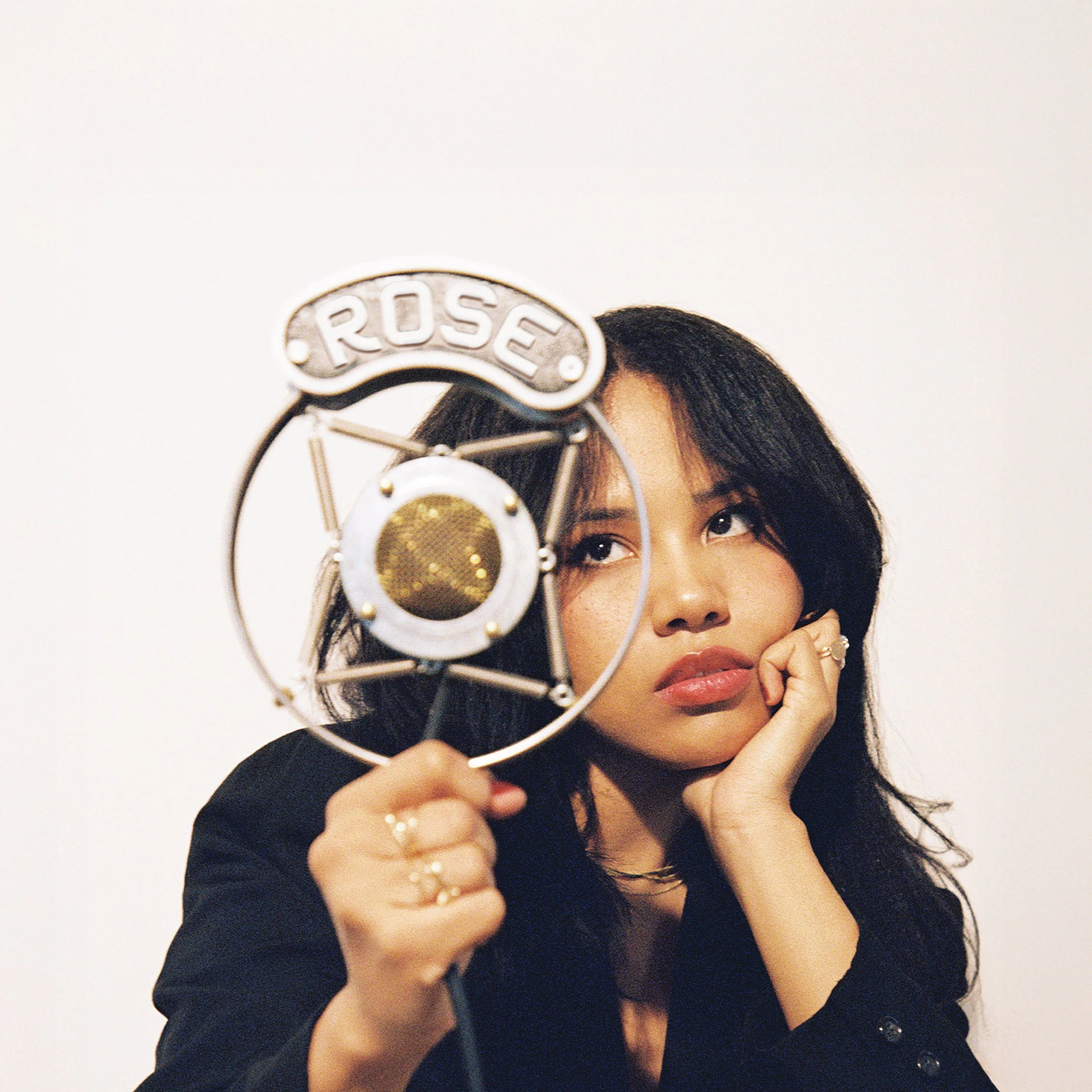
Guuleed: In your music video for ‘But, nvm’ and on the album cover, there is this microphone, which I guess is a totem for the analogue process for making the record. Analogue represents Yearnalism pretty well. It also matches your voice, which is beautiful, something from another era that stands out.
When making this album through an analogue process, what sort of things did you like about recording on tape, getting rid of the excess, and getting to the basics?
Rose: It's so freeing when you limit yourself in a way. We have four tracks, so you don't have time to overthink it, overcook it, punch and do all of these things. It's really focused more on the emotions and rawness of the take. I don't like to do scratch takes. I like to write out the song, practice it in the room, get it right and then go in to cut it with the band.
There's so much discourse about, you know, “Music isn't really fun or easy to create anyway. What's the use? We might as well just use AI.” I think we’re at a crossroads. The timing of myself having these big moments, feels way more meaningful because I'm somebody who wants to preserve the art of the records that made me feel something, and to be a student of that. “Well, what did you use? The EMT-250! The vintage Neumann U67! I want that. I want the RE-16.” Brushing the dust off things, getting things repaired just so that we‘re able to encapsulate the purest sound.
I think that it matters because with every movement, there's resistance; there's always the yin and the yang. To be in this renaissance with incredible artists who also recognise the beauty of skill, craft, humanity and soul. You know what I mean? Real soul. Real experiences. Real love of the craft. Like Leon Thomas, Olivia Dean, Thee Sacred Souls, and Cleo Sol. I could go down the line. I'm in the zeitgeist of showing your work and really proving it.
The mic is an ode to vintage broadcast mics. You know, because Yearnalism is a play on journalism. The album feels like documents. Like my research on desire in all of its different forms. The world-building on this has been so fun. Everything just feels very aligned.
Guuleed: That's something I've really thought about in the last year. There’s some things that come with perfect timing, and it all happens for a reason.
Listen to Baby Rose below.