

Militarie Gun’s Ian Shelton on touring, collaboration and the making of ‘God Save The Gun’

Militarie Gun. Photo credit: Nolan Knight
Interview by Adam Holmes
“With every song people met us at where we were at… We're dedicated to finding the scariest place to go to and wonder if anyone will follow us.… To have people go, yes, I like that experiment in real time. It feels so amazing.” - Ian Shelton on Militarie Gun’s God Save The Gun.
Adam Holmes, drummer for Egosim, a local band from Sydney, caught up with Ian Shelton of Militarie Gun late last year to talk touring, overcoming addiction, the importance of collaboration and the writing process and experimentation that culminated in the band’s latest full length LP, God Save The Gun.
★
Ian: Hey, how's it going?
Adam: Hey Ian, how are you doing?
Ian:Doing great.
Adam: I'm not sure if you remember some kid hopping up to play the drums at your sydney show?
Ian:I do. I was definitely blacked out or close to blacked out, but I do remember it.
Adam: That's the time that we briefly met. It was pretty crazy, man. Like, from memory, that was the end of like a six week tour for you.
Ian: Yeah, it was. We did Europe, US and Australia all back to back. So it was like six weeks of travel.
Adam: That's hardcore as, I couldn’t imagine how tiring and exhausting that would be.
Ian:Very tiring!
Adam: Did you get to do much while you were over here?
Ian:That time, yes. We had so many off days because we had canceled a couple of shows. I went to a vocal doctor and they told me to not play any shows. So we ditched a lot of the headlining shows. We basically only kept the headlining shows in Brisbane, Sydney and Melbourne.
Adam: Yeah true, and since then you've come over with Touche [Amore]. What was that like?
Ian:Much different because we played shows every day! We didn't have the time to go to the beach and do all the casual stuff. But we love Australia and can't wait to come back. That Sydney show we just did was amazing. Getting to play with Shogun from Royal Headache was awesome. It's always been an amazing time.
Adam: Yeah, it was sick, I was at that show. It was so good. I remember you on stage talking about your experience of quitting alcohol. Can you touch on the journey between the first Sydney show and the latest Sydney show with Touche [Amore]?
Ian:Yeah, I feel like it was immediately after that first trip to Australia that I knew that I was in a place of needing to quit. I knew that I was losing my grasp on it and that I probably didn't have a good grasp on it to begin with because I went from having never drank to drinking every day pretty rapidly.
Then I started doing the thing of saying “OK, I'm quitting.” I'd last a tour and then celebrate it by starting drinking again on the last night of tour. It instantly would reemerge as this nasty habit that I couldn't shake. I just had to finally make the decision. Like, “this is what I'm doing now, I'm quitting” and that's what I did.
Adam: Wow. Did you know that was going to be on the new record at all? How far along in the process were you of writing the new album and writing those songs?
Ian: I didn't really plan on getting sober. So it didn't occur to me that it would really crop up in the record. But when I wrote the song, ‘God Save the Gun’, I felt like the lyrics and what I was saying was like trying to give someone else advice without taking it myself. And I felt just looking at the total sum of the record, that this record would be kind of bullshit if I didn't actually make a change in my own life.
Maybe it'd be ironic, maybe it would just be untrue… And I don't want to put something out that's not true. That was kind of the final step, listening to all the demos, kind of fucking up around that time and upsetting someone I care about and being like, “yeah, man, you're not doing great. You need to give it up.”
Adam: That's what I love about Militarie Gun the most. I think it's just your bare honesty, but at the same time you're not making music that is all doom and gloom. It's actually really fun, energetic and anthemic. It's a nice juxtaposition, we can deal with things in life that are quite intense in a really fun way, not everything has to be sadness. It could also be laughing through the sadness.
Ian: I mean, I love Skeleton Tree by Nick Cave. Like those are the records that speak to me the most. I don't naturally gravitate towards just the depressive element. You know, I'm a very depressed person but I also want to go crazy and jump around and have it be a release of that feeling and to get a temporary reprieve from it.
So much of what we've tried to accomplish is offsetting all this terrible stuff with a really fun song. It's also important to capture that, to portray addiction as only being down and out is disingenuous to what the feeling of it is. You might have more bad days than good. But you're chasing that one moment of that fun and the music needs to reflect that. Almost like when you have to feed a dog medicine and you put in a piece of cheese or something, you know?
Adam: Yeah, overall, what you've noticed and what people who struggle with addiction notice is that the fun isn't worth it in the end. What's more important is your health, your mental health, your physical health and being around, being there for people like your friends and family, being there for them. So you could be the best version of yourself for them and have better connections.
Ian: Definitely, that was something that you do miss as you delve deeper into an addiction, the isolation grows and you miss cues, miss things that people need from you because you're so wrapped up in your own shit. That can be extended to normal life as well but it definitely is amplified when you are in an altered state of mind. Songs like ‘Thought You Were Waving’ come from that, just being so caught up in my own life that I'm missing what you need from me.
Adam: Speaking of ‘I Thought You Were Waving’, you played that at the first Sydney show at the Lansdowne. The album announcement had come out. Did you know that that was going to be on the record or that it was going to be a standalone release?
Ian:No, I always knew that was important to what we were trying to say with the record. It was always paired with ‘I Won't Murder Your Friend’ as a call and a response.
We wanted to release it and I'm so happy that we did because it would have been so difficult to pick singles for this record… It was already difficult, but it would have been really difficult if ‘Thought You Were Waving’ had been in the mix at the time too. We released that song and it instantly felt like it was one of our classics.
That’s what this album rollout has felt like. With every single song, it felt like people met us at where we were at. Even though we're essentially a pop rock band, we are very experimental within those boundaries and we're very dedicated to finding the scariest place to go to and wonder if anyone will follow us there. We wouldn't have a song like ‘God Owes Me Money’ had that not been the case. As someone who feels like we're always experimenting to have people go, yes, I like that experiment in real time. It feels so amazing.
Adam: Fully, how important has collaboration been for you in terms of developing these sounds and ideas, these experiments?
Ian: Collaboration is everything to me. What ends up happening is that I start a song and I feel like I know what it should be and I don't always have the tools to make it that. So I just try to call on people smarter than myself. Like James from Dazy is such a smarter musician than I am. Like I'm an idiot musician! Like I'm not good at guitar, I'm not good at singing necessarily.
These people have such a more technical talent and what I think I bring to it is taste. So I can go “yes or no, this, that”, you know, rather than the talent portion of the situation. Same with Phillip Odom, David Kelling. These people were so essential, Riley MacIntyre who produced the album with me, so essential to the shaping of what the songs ended up being from their initial demos. Whether or not those demos were just me or if they were an instrumental idea that I brought or whatever else.
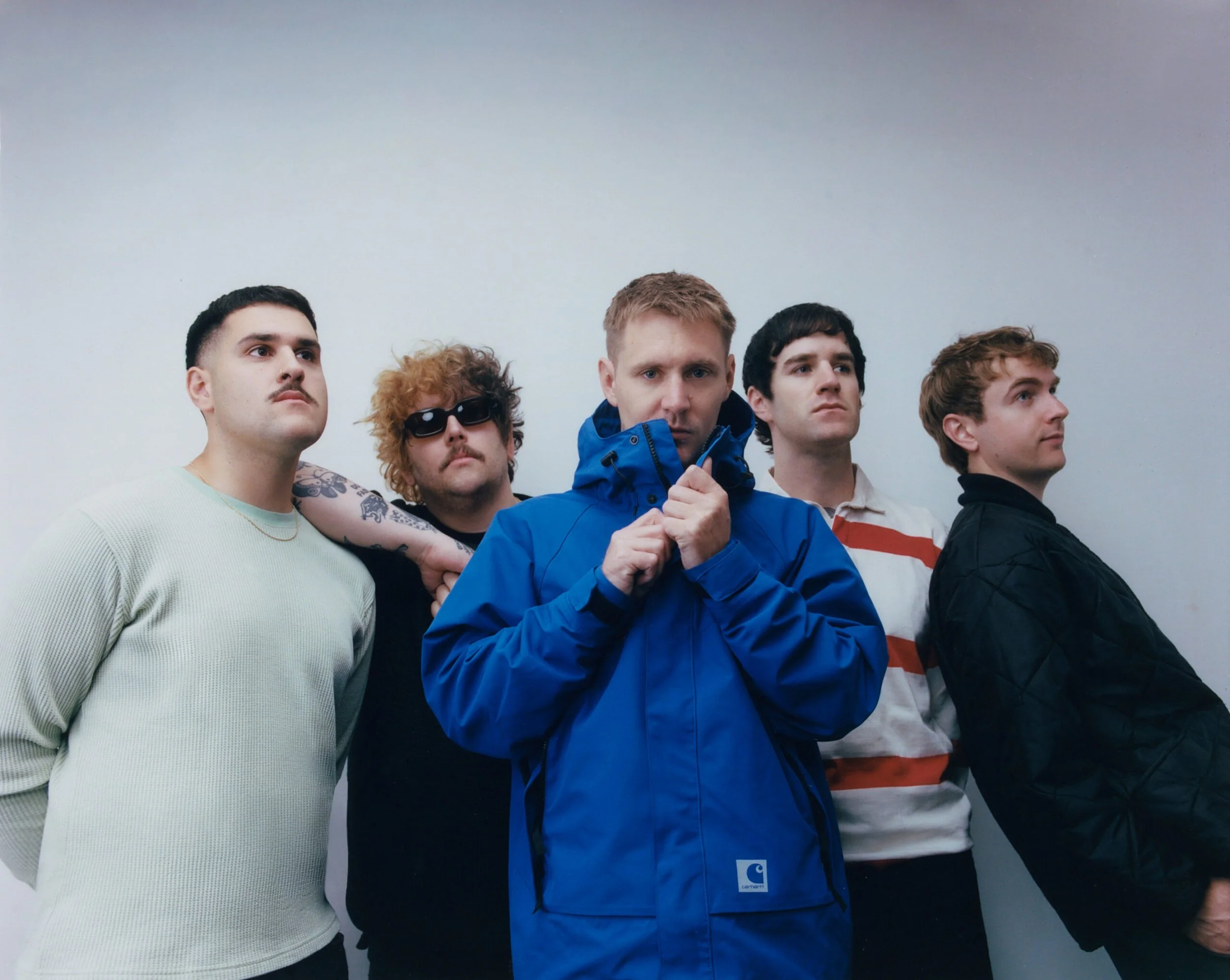
Militarie Gun. Photo credit: Nolan Knight
Adam: Yeah, I feel like I'd be the same. I'm a drummer as well and I can't play guitar for crap, nor bass. I play in a band and every time I have an idea or I have a thousand ideas and it feels like “how do I, how do I communicate this, probably, really simple melody idea as a drummer?” You know, but taste is the most important thing I feel like you can have as a musician. Without that, you're just kind of recreating what other people have created.
Ian: At times it feels similar to making a collage, you know, where you're taking one disparate element from over here and then another from over here and you're like, “ I think I can see these in the same song, but they're not yet in the same song. So how do we do it?”
Adam: What would you say is like the core, is there a core sound or idea within your music?
Ian: No, it's the outward rejection. It's the outward rejection of having one thing. It's embracing the idea that we exist within the time space continuum of music at large and that we could pull from anywhere. We just hope the identity of the band is identifiable enough that you could root through it and find us within that sound.
So for us, it's just a complete rejection of traditionalism. The ideology of it is just, whatever we want. I feel like you can hear that on the record, you know, like it goes from ‘God Owes Me Money’ into ‘Daydream’ and then into ‘Burn My Life Down’. Those are three incredibly different songs.
Adam: Yeah, I like to think that we're post-genre at this point in music as a whole. I think that bands sound like an emotion rather than genres. We're kind of past that point of mashing up genres, or that we’re in like, fifth wave shoegaze or something. At some point it's like, do we even call it a genre anymore?
Ian: It goes back to taste, you know, like at the end of the day, you could pull from very different places but if you don't have the taste to bring it together in the right way, then it's not going to work. You know, like I definitely identify with the idea of being post-genre because I just don't think that I’d ever want to be limited to taking from one place. If it meant that we've made songs people didn't like, I'm okay with that because at the end of the day, I have to perform it every day. So I'm cool with it as long as I like the song.
Adam: You were talking before about Riley producing the record and I want to hear a bit more about what it was like working with him and what kind of sounds he brought to Militarie Gun that you felt were like, “this is it, this is the sound”.
Ian:It was the idea that we approached it as a motion forward. Like it was, the drum distortion reflects what the feeling of the song is, with the guitar tones, if there's a guitar solo, what is the goal of the guitar solo? Is it melodic? On a song like ‘I Won't Murder Your Friend’, literally the statement made during it was that the goal was like the guitar is crying. It's not just playing a guitar solo. Having somebody who's down to have all those esoteric conversations instead of it just being like we set up the mics and we do it, you know?
A song like ‘Daydream’. We went into it very intentionally wanting to record it lo-fi. There's a piano part that's pretty low in the mix but I was like, “I want you to record this piano, the shittiest you've ever recorded a piano”. And he did it. There was no backup. We didn't also do the nice version of mic-ing it at the same time. We only mic-ed it the shitty way. It was like on the outside, bottom of the piano. Like it's not a way that anyone chooses to do it because it doesn't sound good! But the heartbreak of the song was that feeling and that was just it. There wasn't any concern for technicality. It was just concern for emotion. We talked to so many producers and I didn't get that emotion from literally anyone besides Riley.
Adam: So he really came into it like a producer who is an artist, really. Like his artistry was the biggest thing.
Ian: Yeah, definitely and just, you know, the willingness to go off the rails and try something that won't work. Having the time to do it, not looking at the running clock and instead just indulging in every moment that it takes to create what we needed to create and he was there for it.
Adam: That's awesome man. That's really cool. What were you listening to whilst you were writing and recording ‘God Save the Gun’?
Ian:Yeah, I mean, it’s hard for me to remember now because it was three years of writing. So it was like such a huge, huge duration of time and my music taste changed completely over that time.
You know, like Faces was a big inspiration. Kanye West is always a very big inspiration. You could really hear that on ‘I Won't Murder Your Friend’. You can hear that like in ‘The Interruption’ and ‘God Owes Me Money’ and some of the Interlude stuff. The Beatles, always a huge, huge inspiration. I feel like that's pretty… You could track that pretty well on the record.
What else? The 1975 ended up being something I fell in love with during the time of making this record and felt just like, how do I make the fucked up version of this? In some ways. I don't know, yeah, the Ramones. Yeah, it was just big. Anything catchy.
Adam: Right. Yeah, a lot of different things. Did you get a chance to play any drums on the record or did you leave all that to Dave?
Ian: I left it all to Dave! He's a way better drummer than me and he's a left hand lead like Ringo. So he does things like if I make a fill, he puts it into a better pocket because of his left hand lead. I played most of the percussion, I did some auxiliary toms on ‘Bad Idea’. That's me, but otherwise no.
Adam: What would you say was the most fun to record? Like percussion, vocals?
Ian: Vocals are fun. It just feels so good chipping away at the song and being like, “yes, I got it.” You know, like I was nervous. I wouldn't get it and I got it!
Adam: I think my favourite lyric from the record at the moment is “Things You'll Never Remember. I'll Never Get To Forget". I love that lyric a lot because it just talks a lot about how trauma works to the eye of the victim or the person who is experiencing the traumatic event. Did you have any moments while writing lyrics thinking, “holy shit, this is pretty good”?
Ian: Definitely ‘God Owes Me Money’ that was a big one all around because it was just something I was trying to express for so long. There's even an RJC [Regional Justice Center] song called ‘Amnesia’ where the chorus of it is just “Remember, Forget”. So it was something that I'd been hanging on to for a long time. There was a song that was going to be on ‘Life Under The Gun’ that got cut that had that lyric. And it was just because the song wasn't good enough.
I had to listen to the original demo, but I think I came up with that bridge section vocally while we were in the studio and I just remember thinking “Post-Traumatic Feels Too Dramatic”, because ultimately, no matter how much I complain in the songs and try to get all this heavy shit out of my brain, I don't think I'm ever looking for pity. I always have a little bit of a feeling of like, am I being too dramatic? And I think the TikTok-ification of mental health has made it feel really dirty to say post-traumatic, to say a lot of these terms, because it's just like, well, everyone fucking thinks they have that or whatever now. So I felt very proud of “Post-Traumatic Feels Too Dramatic, You're Lucky Your Memory's Just Static. Burned Too Bright Into My Eyes. I Don't Know How We Survived”. I love that passage. I'm so proud of that passage.
Almost all the time when I'm writing lyrics, I go from nothing to that full thing in like 30 seconds. And I don't know where it came from but am so happy it happened. Hit record, you know? I think a similar moment was, “How Are You Going To Say Sorry To The Person Who Discovers Your Body?" Like, that was just like, I felt like I was painting with a hammer when I said it. You know, it just summed up everything I was trying to say with the song. And it felt so good to have that fall out.
Adam: Yeah. And I love the soundbite at the end of that track, right? Where David Choe is talking about Anthony Bourdain. I just think that's so powerful.
Ian: I wanted to recontextualise the idea of suicide. Like, it seems like you're above criticism. Like, I feel like that's what people think on the before side of that incident. I wanted to put out something that was so brutally honest about it from the perspective of wanting to and from the perspective of everyone else in your life. It's just really, ultimately, I wish people would consider how much people would prefer an overburdening phone call of your emotions and everything you need to get off of your chest rather than the phone call that you're no longer on this earth.
I wanted to de-glorify the whole idea of suicide. Because I think it seems very glorious. You know, we grow up just thinking about these rock stars that we want to be and how they've committed suicide and drug overdose or anything else. Instead of communicating their desperation, they chose another way out. I don't want to be that story. I hope that maybe someone else could consider not being that story as well.
Adam: Yeah. There's a lot more, there's a lot of hope to life. We can move on to other things and find purpose and meaning, especially in things like music.
Ian: Yeah. I mean, that's the only reason I'm still here is music. You know, had I not had the thrust, I mean, I've literally had the thought multiple times, well, I can't kill myself. I have the recording coming up on this day. You know, like, it does get that casual in your mind, in my own mind about it at times. And without it, I wouldn't be here. So I'm grateful for it.
Adam: In my own way, I live with a chronic illness. So mine is less mental. It's more physical. This feeling that I've been handed the short straw in life. So when I listen to Militarie Gun, there is, for me, there's a recontextualization in my mind, being like, “yeah that fucking sucks and I’ve been through so much trauma and it’s been very difficult and it continues to be very very difficult but I can listen to Militarie Gun and go for a run, jump around my house”, you know, the music makes me feel really excited to be alive.
Even though lyrically it’s otherwise or seems to be otherwise lyrically but it’s not about that. It's about just enjoying yourself while you’re here with all the baggage you have, yeah it’s just so powerful man.
Ian: That's our goal, thank you for that.
Adam: Are you still doing Regional Justice Centre?
Ian: We played a festival recently, I want to write some more, I want to play more shows. It's just very difficult with the Militarie Gun schedule to set aside time for that.
Adam: Oh man it fucking gets me going [laughs] I was listening to it yesterday, I actually played drums to it for a little bit but I was bouncing around the house going a little bit crazy [laughs].
Ian: Hell yeah.
Adam: I love how you can hear, I want to say Militarie Gun influence in RJC but I’m sure it’s the other way around, you have been doing RJC for longer than you’ve been doing Militarie Gun but there are things within that music that exist in Militarie Gun at the same time.
Ian:Well that was when I first started ripping off The Beatles was in RJC, I do a whole Ringo drum part from 'The End’ or I take a rhythm for a breakdown from ‘Something’ you know? There was one song where I took a thing from Robin Trower, you know? That was where I first started trying to channel the idea of taking from classic rock bands.
Adam: I never would have guessed that to be honest [laughs]. What’s it like playing drums and doing vocals? Is that tricky? I’ve never done that before.
Ian:Oh it’s so bad! It’s terrible! [laughs] It is so taxing and that is why I’m so happy that my brothers sing for the band now and I do way less vocals.
Adam: Alright man, thank you so much for taking the time out of your day. I really appreciate it.
Ian:Awesome man, thank you so much for doing this. Hopefully we see you in Sydney next time.
Adam: I’ll be there!
Listen to God Save The Gun below.